
Hebei Jingye Precision Pipe Manufacturing Co., Ltd.
Tel:+8615373142593
+8618031823787
+8618932936052
WhatsApp: +86 15373142593
E-mail :steeltube@hbjyjt.com
Add: No. 10, Dongzhuang Vilage, Nandian Town, Pingshan County, Shijiazhuang City, Hebei Province
Proper handling and stacking are critical to keep round steel pipes from rolling, bending, deforming, scratching and rusting during storage. Standard operation protects roundness, straightness and surface quality, and also facilitates inventory management and later picking.
First, standard handling rules. Use professional lifting equipment such as forklifts and cranes with soft cushion supports. Do not use steel wire ropes to directly bind the pipe body, which will cause indentation and local bending. Avoid rough throwing, dragging or rolling pipes on the ground to prevent surface scratches and pipe end damage. When carrying in batches, keep the pipes balanced and steady, and do not tilt or drop them. Keep the original protective film, end caps and anti-rust layer intact during all handling processes.
Second, ground cushioning preparation before stacking. Never place round steel pipes directly on bare ground. Lay wooden sleepers, rubber pads or steel brackets evenly on the ground. The cushion height should be enough to isolate the pipes from ground moisture, avoid soaking and rusting, and support the pipe body evenly to maintain straightness without bending deformation.
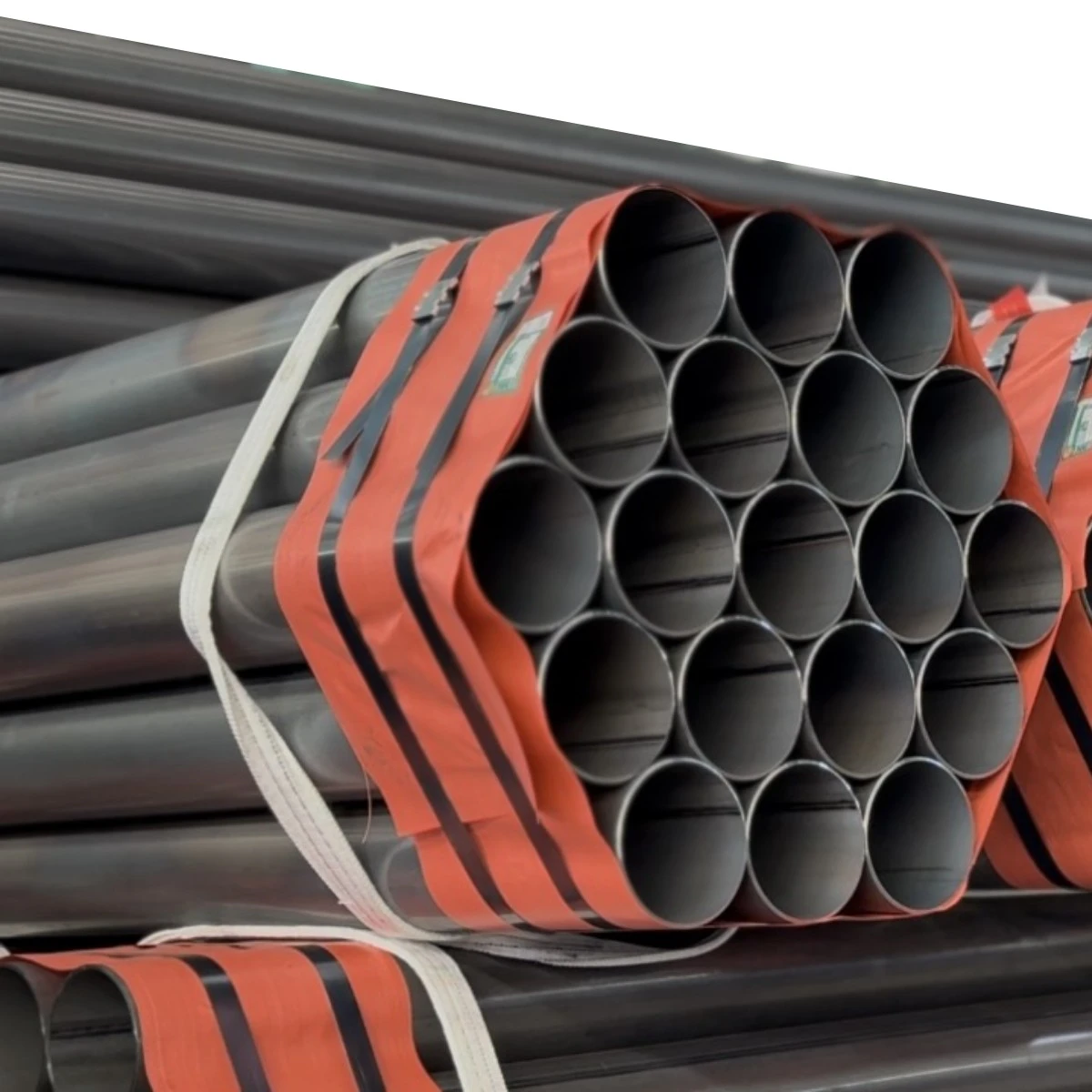
Third, scientific stacking method. Classify round steel pipes by outer diameter, wall thickness, material grade and length, stack the same specification together and avoid mixed stacking of different sizes. Arrange each layer in neat horizontal rows, place limit baffles on both sides to prevent rolling and collapsing. Place thick-wall and high-rigidity pipes at the bottom as supporting layers, and thin-wall pipes on the upper layer to avoid being squeezed into oval shape. Control stacking height properly; too high will bring collapse risk and pressure deformation to the bottom pipes.
Fourth, leave gaps and keep ventilation. Reserve small gaps between pipe layers and between each stack to ensure air circulation. This reduces moisture accumulation, avoids damp condensation, and effectively prevents surface oxidation and rust. Do not stack pipes tightly sealed without gaps in humid weather or coastal areas.
Fifth, fixed protection and daily arrangement. For high stacks, use strapping belts to fix the whole pile to prevent sliding and loosing. Keep pipe ends aligned neatly to avoid collision damage. Make clear marks on each stack for specification, material and batch, follow first-in first-out principle. Regularly tidy up messy stacks, check for deformation or rust, and adjust stacking structure in time if any hidden risk appears.
In short, correct handling and stacking of round steel pipes require gentle carrying, reasonable cushioning, classified neat stacking, anti-rolling protection and ventilated placement. Following these steps can well protect pipe appearance, roundness and mechanical performance during long-term storage.


Contact Information: +86 15373142593, +86 18031823787, +86 13472220366 (WeChat available)
WhatsApp: +86 15373142593
Address: No. 10, Dongzhuang Village, Nandian Town, Pingshan County, Shijiazhuang, Hebei Province